


MapTap Turns Daily Geography Into a Competitive Wordle-Style Habit
A new daily geography game called “MapTap” is gaining attention as a fresh alternative to Wordle, offering players a location-based challenge that blends education, competition, and social sharing in a format designed for quick daily engagement.
Table Of Content
As Wordle continues its long-running cultural presence after more than five years, some players have started looking for alternatives that feel less like routine streak maintenance and more like active problem-solving. MapTap has emerged as one of those alternatives, reshaping the daily puzzle format around geography and spatial reasoning rather than vocabulary.
Available both as a mobile app and web game, MapTap challenges players with five daily questions. Each question presents a city, landmark, or historically significant site, and players must tap its approximate location on a world map.
A Simple Concept Built Around Geographic Guessing
The core mechanic of MapTap is straightforward but increasingly challenging. Each round presents a location-based prompt, starting with well-known cities such as London and progressing toward more obscure or geographically remote places, including island nations or historical battle sites.
Players receive a score from 0 to 100 based on how close their guess is to the correct location. The difficulty increases with each successive question, and later rounds introduce score multipliers, meaning accuracy on harder questions can significantly impact the final result.
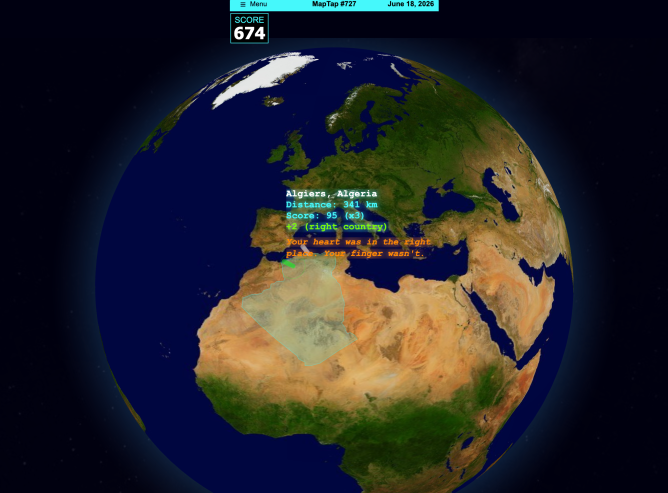
At the end of the five-question sequence, players receive a total score out of 1,000, creating a clear competitive benchmark for daily performance.
This structure combines immediate feedback with cumulative scoring, encouraging both short-term engagement and long-term improvement.
Social Sharing and Competitive Play Drive Engagement
Like Wordle and other daily puzzle games, MapTap includes a built-in sharing feature that generates a text-based score summary. Players can copy and paste their results into messaging apps or group chats, turning individual gameplay into a social comparison experience.
A typical result might look like a sequence of scores and emojis representing performance across each question, followed by a final total score. This format encourages friendly competition, as players compare not just whether they completed the puzzle, but how efficiently they identified each location.
The social dimension is a key part of the game’s appeal, particularly among groups of friends who use it as a daily shared ritual.
A Learning Tool Disguised as a Game
Beyond its competitive structure, MapTap also functions as an informal geography learning tool. Players are exposed to a wide range of global locations, including less familiar regions, which gradually improves spatial awareness over time.
After completing each daily puzzle, the game provides short informational summaries about the featured locations. These descriptions often include historical or cultural context, turning each session into a brief educational experience rather than just a test of prior knowledge.
Some daily challenges even incorporate thematic content, such as historical journeys or famous explorers, adding narrative context to the geographic tasks.
A Different Approach From Other Geography Games
MapTap enters a growing ecosystem of geography-based puzzle games, but it differentiates itself from similar titles like Worldle and Globle through its “best-guess” design.
While other games in the genre often require exact identification of countries or rely heavily on elimination strategies, MapTap allows players to make approximate guesses and still receive meaningful feedback. Even incorrect answers provide a score indicating proximity to the correct location, which helps players learn iteratively rather than being penalized for uncertainty.
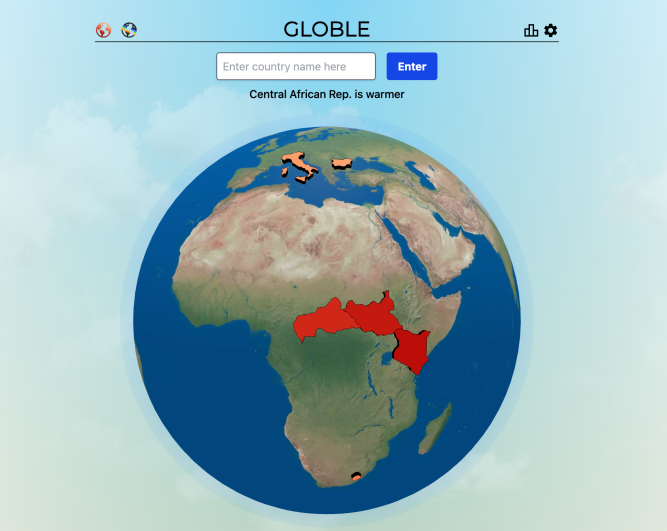
This feedback loop makes the game more forgiving and encourages experimentation, especially for players who may not have deep geographic knowledge but are willing to learn through repetition.
Why It Fits the Wordle-Era Puzzle Culture
MapTap follows the established formula popularized by Wordle: a simple daily challenge, limited attempts, and a shareable result that invites social comparison. However, it shifts the focus from language to global awareness, appealing to players who want a more visual and spatial form of puzzle-solving.
Its appeal also reflects a broader trend in casual gaming, where short-form daily experiences are replacing longer, more immersive games for some users. The combination of routine, competition, and gradual skill improvement makes it particularly well-suited for habitual play.
A New Kind of Daily Habit Game
As players cycle through increasingly familiar puzzle formats, MapTap represents a subtle evolution of the genre. It retains the simplicity that made Wordle successful but replaces word deduction with geographic intuition and learning.
For many players, the appeal lies not in perfection but in improvement—gradually recognizing more of the world through repetition, mistakes, and small daily challenges.
Whether it becomes a long-term staple or another entry in the expanding family of daily puzzle games, MapTap highlights how simple mechanics can still feel fresh when paired with curiosity about the real world.