Most Popular Messaging Apps in 2026: WhatsApp Still Dominates Global Communication
Messaging apps continue to be one of the most widely used categories of digital platforms worldwide, with WhatsApp maintaining a dominant lead over competitors such as WeChat, Telegram, and Facebook Messenger. In 2026, global usage remains highly concentrated among a small number of platforms, while newer apps compete through niche features, privacy positioning, and monetization models.
Table Of Content
- WhatsApp Leads the Global Messaging Market
- Global Ranking of Messaging Apps by Users
- Messaging App Downloads and Growth Trends
- Revenue Leaders in Messaging Apps
- WhatsApp’s Global Reach and Market Penetration
- Regional Differences Shape the Messaging Landscape
- The Shift Toward Super Apps and Platform Ecosystems
- Conclusion: A Highly Concentrated but Rapidly Evolving Market
Across mobile ecosystems, messaging is no longer just about sending texts—it now includes payments, communities, media sharing, business tools, and even content discovery. Despite this expansion, user attention remains heavily centralized around a few major players.
WhatsApp Leads the Global Messaging Market
WhatsApp remains the world’s most widely used messaging app, with approximately 3 billion monthly active users. This places it far ahead of any competitor and reinforces its position as the primary global communication platform.
The app’s growth has been driven by its simplicity, cross-platform availability, and strong network effects. In many countries, WhatsApp has effectively replaced SMS as the default communication tool.
Key highlights include:
- ~3 billion monthly users worldwide
- Estimated revenue of around $3 billion in 2026
- Approximately 150 billion messages sent daily
- Ranked as the most popular messaging app in the majority of countries globally
WhatsApp also maintains strong global web traffic and engagement, reflecting its role not only as a messaging tool but as a broader communication infrastructure.
Global Ranking of Messaging Apps by Users
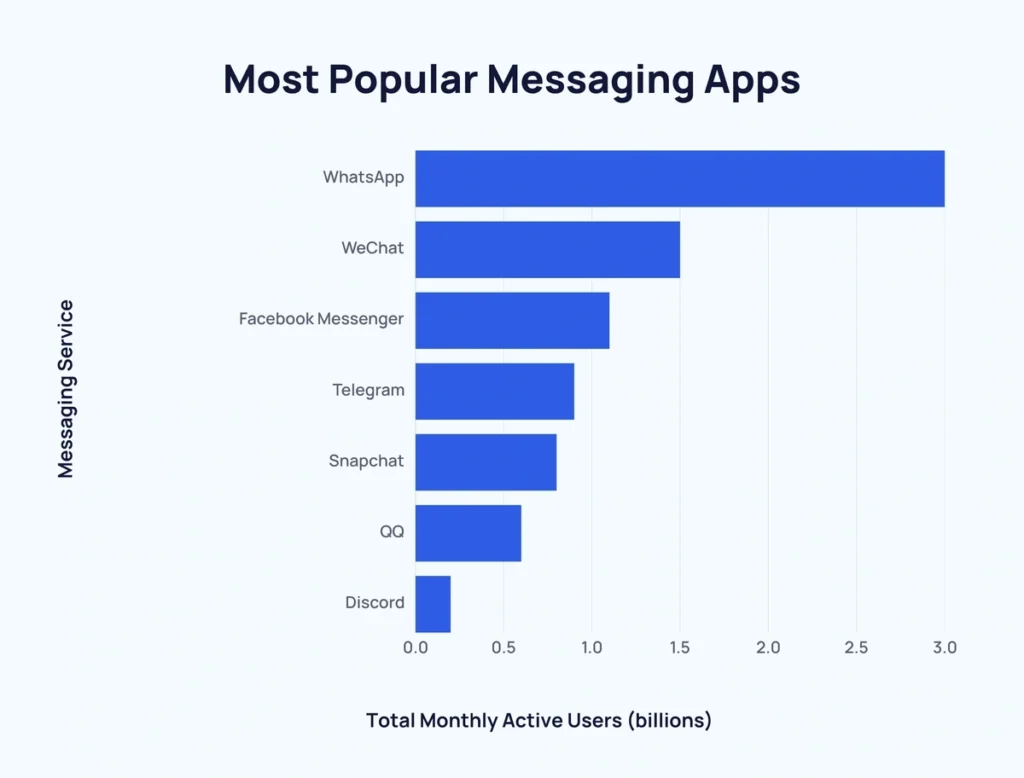
The global messaging landscape is highly concentrated, with a small number of platforms accounting for the majority of active users:
| Rank | Messaging App | Monthly Active Users |
|---|---|---|
| 1 | 3.0 billion | |
| 2 | 1.41 billion | |
| 3 | Facebook Messenger | 1.01 billion |
| 4 | Telegram | 1.0 billion |
| 5 | Snapchat | 932 million |
| 6 | 532 million | |
| 7 | Discord | 200 million+ |
While WhatsApp leads globally, WeChat dominates in China as a multifunctional “super app,” combining messaging with payments, services, and commerce. Meanwhile, Telegram has grown rapidly into a billion-user platform, particularly popular for large communities and broadcast channels.
Messaging App Downloads and Growth Trends
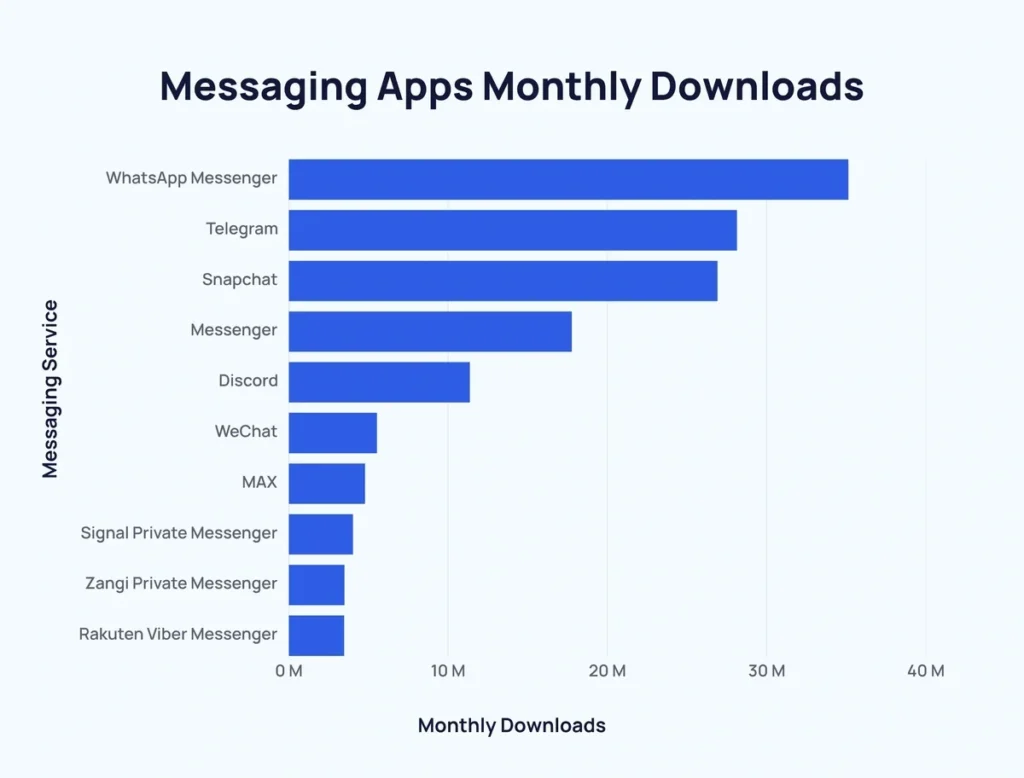
When measured by downloads, competition becomes tighter:
- WhatsApp Messenger: ~35 million monthly downloads
- Telegram: ~28 million monthly downloads
- Snapchat: ~27 million monthly downloads
- Facebook Messenger: ~18 million monthly downloads
- Discord: ~11 million monthly downloads
These figures suggest that while WhatsApp leads in total users, Telegram and Snapchat continue to grow rapidly through strong adoption among younger users and communities focused on media, privacy, and group communication.
Revenue Leaders in Messaging Apps
Messaging platforms increasingly rely on in-app purchases, premium subscriptions, and digital services rather than traditional advertising alone.
Top revenue-generating messaging apps include:
| Rank | App | Monthly In-App Revenue |
| 1 | Snapchat | ~$50.83M |
| 2 | Telegram | ~$19.91M |
| 3 | LINE | ~$18M |
| 4 | Discord | ~$14.69M |
| 5 | ~$13.23M |
Interestingly, Snapchat leads in monetization per user engagement, despite having fewer total users than WhatsApp or WeChat. This reflects its strong focus on ads, augmented reality features, and premium content tools.
WhatsApp’s Global Reach and Market Penetration
WhatsApp’s dominance is particularly evident in global penetration rates:
- Over 54% of global internet users aged 16+ use WhatsApp monthly
- Penetration exceeds 90% in more than 10 countries, including Brazil, Mexico, Morocco, and Spain
- Usage is significantly lower in markets like the US (around 30%), China, and Japan
In many emerging markets, WhatsApp functions not just as a messaging app but as a primary communication and business platform, often replacing email, SMS, and even basic customer service channels.
Regional Differences Shape the Messaging Landscape
Messaging app dominance varies significantly by region:
- Latin America & Africa: WhatsApp is the default communication tool
- China: WeChat dominates as a super app ecosystem
- Russia & parts of Eastern Europe: Telegram has strong penetration
- US & Western markets: More fragmented usage across WhatsApp, iMessage, Messenger, and Snapchat
These regional differences reflect not only user preference but also regulatory environments, telecom history, and the evolution of mobile internet adoption.
The Shift Toward Super Apps and Platform Ecosystems
Modern messaging apps are evolving beyond simple chat functions:
- WeChat integrates payments, shopping, and services
- Telegram focuses on channels, communities, and large-scale broadcasting
- Snapchat emphasizes content creation and augmented reality
- Discord has become a hub for gaming, communities, and live interaction
This evolution suggests that messaging apps are increasingly becoming digital ecosystems, rather than standalone communication tools.
Conclusion: A Highly Concentrated but Rapidly Evolving Market
Despite the emergence of new platforms and features, the messaging app market remains heavily concentrated around a few dominant players—especially WhatsApp.
However, competition continues to intensify in areas such as:
- Community-building (Telegram, Discord)
- Monetization and creator tools (Snapchat)
- Super app functionality (WeChat, increasingly WhatsApp and others)
As messaging platforms expand into payments, content, and services, the distinction between communication apps and full digital ecosystems continues to blur, shaping the next phase of global mobile internet usage.